
If you have one bedroom that never cools down, an electric bill that keeps climbing, or a house that’s dusty no matter how often you clean, the problem may not be your AC unit at all. It may be the ductwork carrying the air.
According to ENERGY STAR, in a typical house about 20 to 30 percent of the air moving through the duct system is lost to leaks, holes, and poorly connected ducts. In North Texas, where most ducts run through the attic, that lost air isn’t just wasted. It’s being dumped into one of the hottest spaces on your property.
Why leaky ducts hurt more in Texas
On a 100-degree DFW afternoon, your attic gets far hotter than the outside air. Your AC is working hard to make air at around 55 degrees, then sending it through ducts surrounded by that heat. Every leak along the way does two kinds of damage:
- Supply leaks blow cold air you already paid for into the attic, so it never reaches your rooms.
- Return leaks pull hot, dusty attic air back into the system, so the AC has to cool attic air on top of house air, and that dust ends up in your living space.
The result is an AC that runs longer, rooms that never feel even, higher bills, and more wear on equipment that’s already running most of the day all summer.
Signs your ducts are leaking
- Rooms that are hard to cool or heat compared with the rest of the house
- High summer and winter utility bills
- Stuffy rooms or weak airflow from some vents
- Excess dust, or dust streaks around supply registers
- Ductwork in the attic, garage, or crawlspace, especially older flex duct
- An AC system that runs constantly but can’t keep up on hot afternoons
The problem with sealing ducts by hand
The traditional fix is to go into the attic with mastic and foil tape and seal every joint you can reach. That works for the leaks you can see. But many of the worst leaks are hidden inside walls, under insulation, behind the air handler, or at boots buried in ceiling cavities. You can’t seal what you can’t reach. (And standard cloth duct tape doesn’t last. It dries out and falls off in Texas attic heat.)
How Aeroseal works
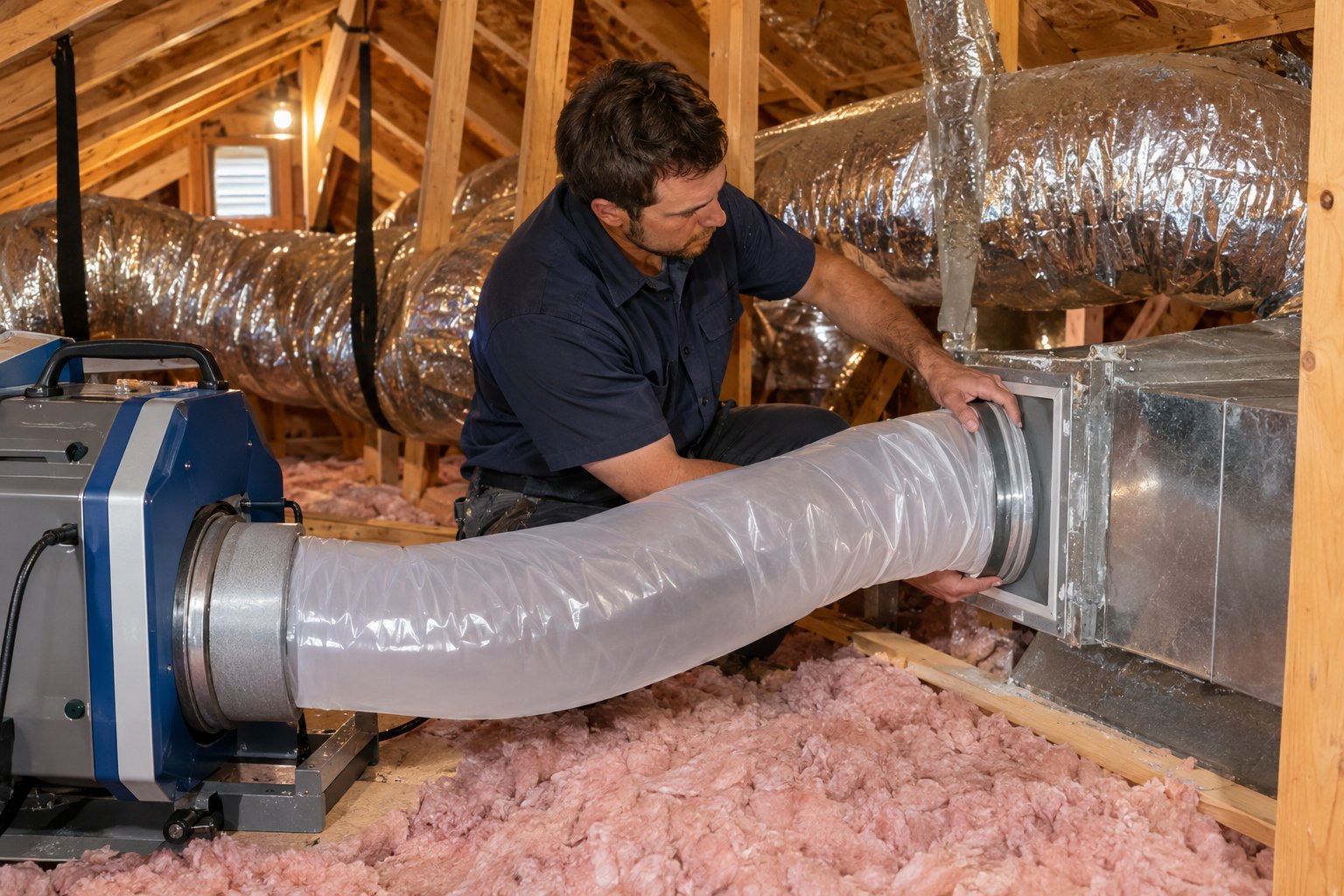
Aeroseal seals ducts from the inside. Here’s the process:
- Measure first. We block off the registers, protect the furnace, coil, and sensors, and connect the Aeroseal equipment to the duct system. A pretest measures exactly how leaky your ducts are.
- Seal from the inside. The system pressurizes the ducts and blows in a non-toxic aerosol sealant. As air escapes through the leaks, the sealant particles collect at the edges of each hole and build up until it closes. The sealant only sticks where there’s a leak. It doesn’t coat the inside of your ducts.
- Prove it. The computer tracks leakage in real time, and you get a before-and-after report showing how much leakage was sealed.
Research summarized by the U.S. Department of Energy’s national laboratory notes that aerosol sealant can close small, inaccessible duct leaks up to about half an inch across, including leaks hidden in walls, ceilings, and floors that can’t be sealed by hand.
What sealing your ducts can do
- Lower energy bills, because the cold air you pay for actually reaches your rooms
- More even temperatures from room to room
- Less dust and attic air pulled into the house, which helps indoor air quality
- Less strain on your AC, which can help it last longer
- Better results from a new system. If you’re replacing your AC, sealing the ducts first means you’re not hooking new equipment up to a leaky system.
Is duct sealing right for your home?
Not every house needs it, and we’ll tell you if yours doesn’t. If your ducts are crushed, badly undersized, or falling apart, replacement may be the better answer. If they’re in decent shape but leaky, sealing is usually one of the best values in home comfort.
Brayden J Mechanical serves Haltom City, Fort Worth, North Richland Hills, Keller, Haslet, Saginaw, Southlake, and the rest of DFW. Schedule a duct evaluation or call (682) 277-9944. Texas HVAC License TACLA145034C.