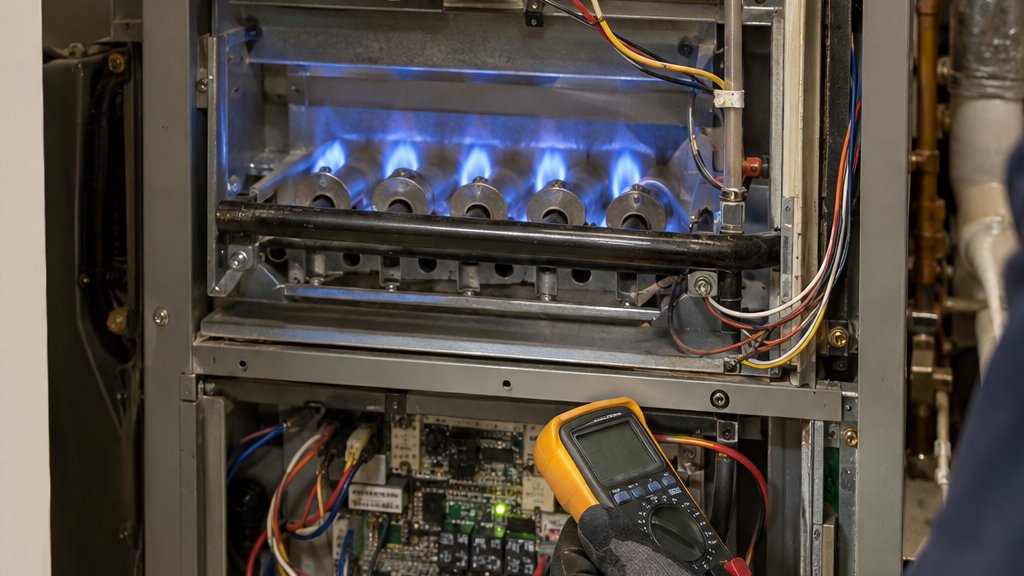
The first real cold front rolls into DFW, you bump up the thermostat, and nothing happens. No click, no fan, no warm air. Before you call anyone (including us), take five minutes and go through these six checks. A lot of the time you’ll fix it yourself. If you can’t, you’ll be able to tell the technician exactly what’s going on, which saves diagnostic time and money.
1. Check the thermostat
It sounds obvious, but it’s still the number one reason people think the furnace is broken.
- Is it set to Heat, not Cool or Off?
- Is the setpoint at least 3°F above the current room temperature?
- If it runs on batteries, when did you last change them? Swap them now.
- If it’s a smart thermostat, check for an error message or a frozen screen. Pull it off the wall plate for 30 seconds and reseat it.
If the display is completely blank, either the batteries are dead or the low-voltage wiring back to the furnace has a problem. Try batteries first.
2. Check the furnace power switch
Most furnaces have a switch that looks like a regular light switch, mounted on the furnace cabinet or on a nearby wall. It often gets flipped off during summer or bumped when stuff gets stored in the closet or attic. Make sure it’s on.
3. Check the breaker
Go to your electrical panel and find the breaker labeled “furnace” or “air handler.” If it’s tripped (sitting between on and off, or fully off), reset it firmly. If it trips again right away, stop. That’s an electrical problem that needs a professional. Don’t keep resetting a breaker that keeps tripping.
4. Check the filter
A badly clogged filter can trip the furnace’s high-limit safety switch, which shuts the burners down to keep the furnace from overheating. Pull the filter out. If you can’t see light through it, replace it. If the furnace fires up 10 minutes later, you found the problem.
While you’re at it, set a reminder: every 90 days for 1-inch pleated filters, and every 6 months for 4- to 5-inch media filters.
5. Check the condensate drain (high-efficiency furnaces)
If your furnace is a high-efficiency model (you’ll see white PVC pipes running out of it), it produces water that drains through a small line. If that line clogs, a safety float switch shuts the whole system off.
Look for a small clear tube or PVC pipe near the base of the furnace, sometimes running to a floor drain or a condensate pump. Standing water in a nearby pan or a backed-up drain hose means the drain is clogged. Clearing it usually means taking the trap apart carefully, so this one is often worth a call.
6. Check the gas supply
If you have a gas furnace and none of the above worked:
- Is the gas valve on the pipe going into the furnace open? Handle parallel to the pipe means open. Perpendicular means closed.
- Do your gas stove burners light? If not, you may have a supply problem. Call your gas company.
- If you smell gas, don’t troubleshoot. Leave the house right away and call the gas company or 911 from outside. Don’t flip light switches or use your phone inside.
When to stop and call a pro
Stop troubleshooting and call a licensed HVAC technician if:
- You’ve checked all six items and it still won’t start
- The furnace starts but shuts off within a few minutes (short cycling can be a dirty flame sensor, a high-limit problem, or a venting issue)
- You hear loud banging, booming, or a delayed ignition sound
- You see yellow or orange flames instead of blue
- You smell gas, even faintly
- The breaker trips more than once
Furnaces combine high-voltage electrical, natural gas, and carbon monoxide risk. The safe DIY stuff ends at the thermostat, the filter, the power switch, and a one-time breaker reset. Past that, a diagnostic visit is cheaper than guessing.
What to have ready when you call
If you end up calling us at (682) 277-9944, having this ready shortens the visit:
- The furnace brand and model number (usually on a sticker inside the cabinet door)
- The approximate age of the system
- What you already tried from this list
- What you’re seeing: no ignition, starts and stops, or blowing cold air
Prevent the no-heat call next year
Most of the furnaces we find dead on the first cold night had a warning sign months earlier: a dirty flame sensor, a weak igniter, or a clogged filter. A fall tune-up catches those before they leave you without heat. Our $59 preventative maintenance visit covers the heating side and the cooling side.
Brayden J Mechanical services all makes and models of gas furnaces and heat pumps across Haltom City, Fort Worth, Haslet, Keller, Saginaw, Southlake, and the rest of DFW. Schedule service online, see our HVAC services, or call (682) 277-9944. Texas HVAC License TACLA145034C.