The first cool morning in North Texas is usually the first time all summer that homeowners think about their heat. It’s also the worst time to find out something’s wrong.
If you live in Haslet, Keller, Saginaw, Southlake, or anywhere else in DFW, September and October are the two months to get your HVAC system checked. Here’s what a real fall tune-up covers, why it saves money, and what to watch for.
Why fall, and not the first cold snap?
Two reasons. First, your system just ran for four straight months of Texas heat — the compressor, blower motor, and capacitor all took a beating. Small issues that didn’t show up while cooling will show up the moment you switch to heat. Second, when the first cold front hits and everyone’s furnace kicks on at once, every HVAC company in DFW is booked out for a week. A tune-up in September is a $59 appointment. A no-heat call in December is a diagnostic fee plus whatever’s actually broken plus the wait.
What a real fall tune-up covers
Not all “tune-ups” are the same. Some companies show up, glance at your system, hand you a filter, and call it done. That’s not a tune-up — that’s a filter change with a service fee. Here’s what should actually happen on the visit:
- Heat exchanger inspection. This is the single most important item on a gas furnace check. A cracked heat exchanger leaks carbon monoxide into your home. The tech should visually inspect it and, on older systems, use a combustion analyzer.
- Burner cleaning and flame check. Gas burners collect dust and rust over the off-season. Dirty burners run inefficient and short-cycle.
- Blower motor and belt. Amp draw checked against spec. Wheel cleaned if needed.
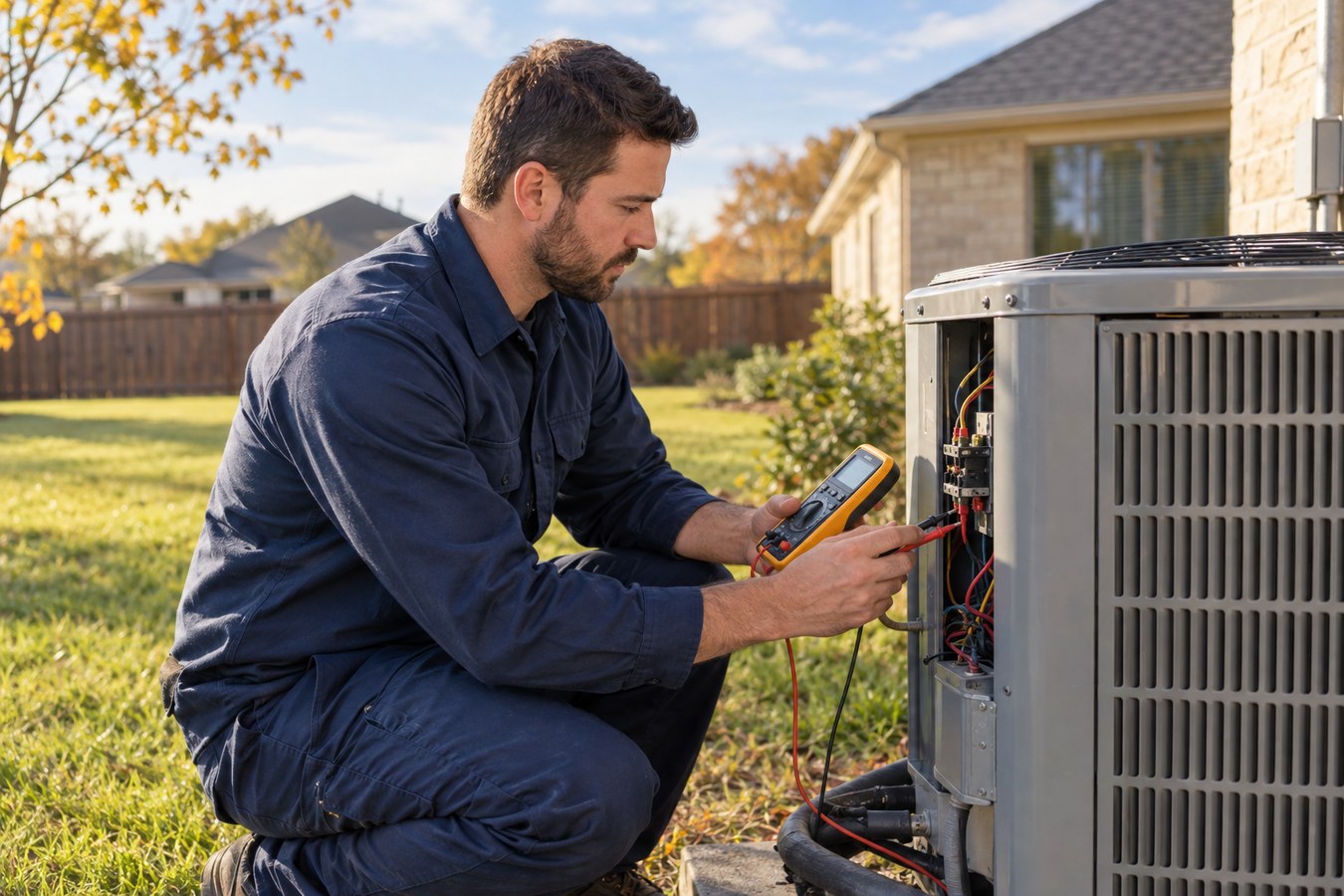
- Capacitor test. Weak capacitors are the #1 cause of no-heat and no-cool failures. A tech with a meter can catch a failing one in ninety seconds.
- Thermostat calibration. A thermostat two degrees off costs you real money over a winter.
- Refrigerant check (heat pump systems). If you have a heat pump instead of a gas furnace, refrigerant charge affects heating performance just like it affects cooling.
- Filter change and a recommendation on filter grade for your specific system.
- Safety checks — gas pressure, flue draft, condensate drain.
You should get a written report showing what was checked, the readings, and any recommendations. If you don’t get paperwork, you didn’t get a tune-up.
What DFW’s climate does to HVAC systems
Fort Worth, Haslet, Keller, and the rest of the Metroplex put more stress on HVAC equipment than almost anywhere in the country. Long, hot summers mean cooling equipment runs 8+ months a year. Rapid weather swings — 80°F on Monday and 35°F on Wednesday — force systems to switch modes constantly, which wears out reversing valves on heat pumps and short-cycles gas furnaces. A tune-up here matters more than in a milder climate.
Signs you shouldn’t wait until fall
Call now, not later, if you notice any of these:
- Uneven heating or cooling between rooms
- A burning smell the first time the heat runs (small amount of dust is normal; sustained smell is not)
- Any grinding, squealing, or rattling sound
- Utility bill higher than the same month last year without a rate change
- System over 12 years old that hasn’t been serviced in the last 18 months
The bottom line
Our $59 fall tune-up prevents most $800 winter emergencies. It also extends the life of the equipment — properly maintained systems last 15+ years, neglected ones fail at 8-10. Whether you use Brayden J Mechanical or someone else, get your system checked before Halloween.
If you’d like us to handle it, schedule an estimate or call (682) 277-9944. We service Haslet, Keller, Saginaw, Southlake, and the rest of Dallas–Fort Worth. Licensed, insured, and Marine veteran-owned.